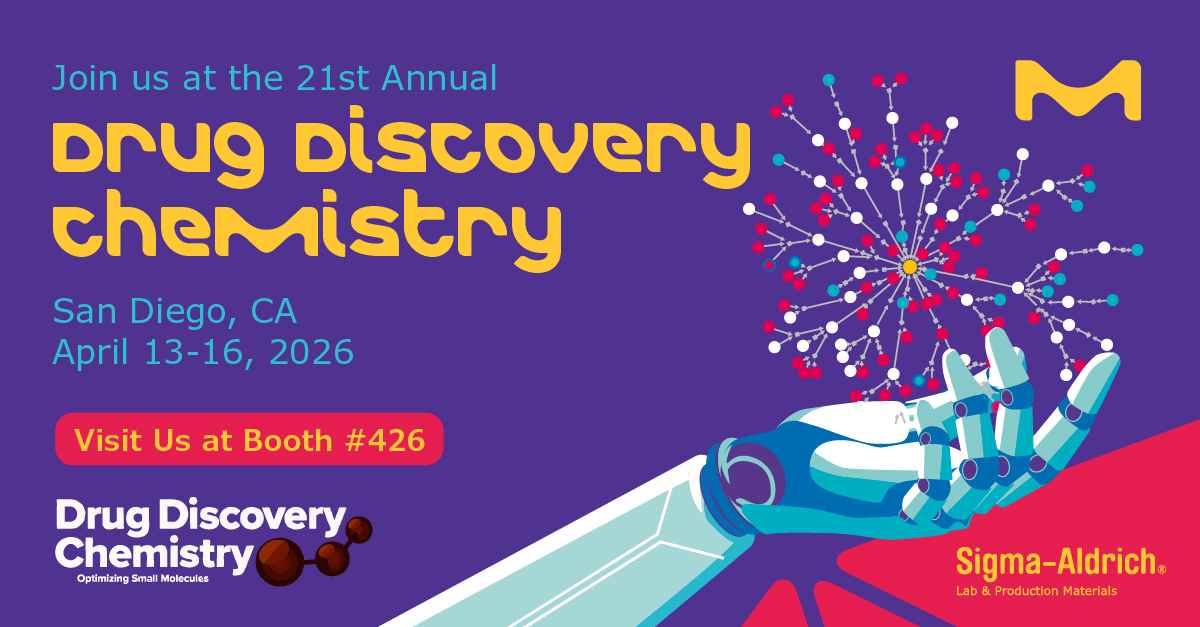
Drug Discovery Chemistry 2026
📅 Date & Time: Apr. 13 – 16, 2026
🧭 Location: San Diego, CA
Today’s Synthetic Molecules for Tomorrow’s Therapeutics
Drug Discovery Chemistry in San Diego is where medicinal, biophysical, and computational chemists pressure‑test the latest ideas in small‑molecule discovery—fragment-based design, degraders and molecular glues, oral macrocycles, DNA‑encoded libraries, and AI/ML‑driven design all under one roof. If you’re trying to move from interesting concepts to real, makeable candidates, this is one of the most relevant meetings on the calendar.
At Booth #426, we’re bringing two sides of the same story together:
- AIDDISON™ for generative, AI‑powered molecule design and prioritization
- SYNTHIA® Retrosynthesis Software for turning those designs into robust, practical synthetic routes
You’ll see how AIDDISON™ can explore huge swaths of chemical space, optimize for ADMET and project‑specific properties, and then hand over only the most promising ideas to SYNTHIA®. From there, SYNTHIA® rapidly proposes multiple synthetic pathways starting from millions of commercially available building blocks, with filters for step count, cost, green chemistry constraints, and route robustness. Together, they form a closed loop: design → score → check synthesizability → plan routes—before you’ve ordered a single reagent.
For discovery teams, we’ll focus on how this combined stack supports fragment-to-lead, beyond‑Ro5 modalities, degraders and molecular glues, and macrocycles, including library design that is both innovative and actually synthesizable. For process and scale‑up chemists, we’ll show how SYNTHIA® is used to rethink routes around supply risk, cost, and sustainability once a candidate emerges from discovery.
If you’re coming to San Diego for the cutting‑edge science, stop by Booth #426 to see how AIDDISON™ and SYNTHIA® can help you close the gap between virtual design and real chemistry—so your next generation of drug candidates moves from idea to synthesis faster, greener, and with far fewer dead ends.